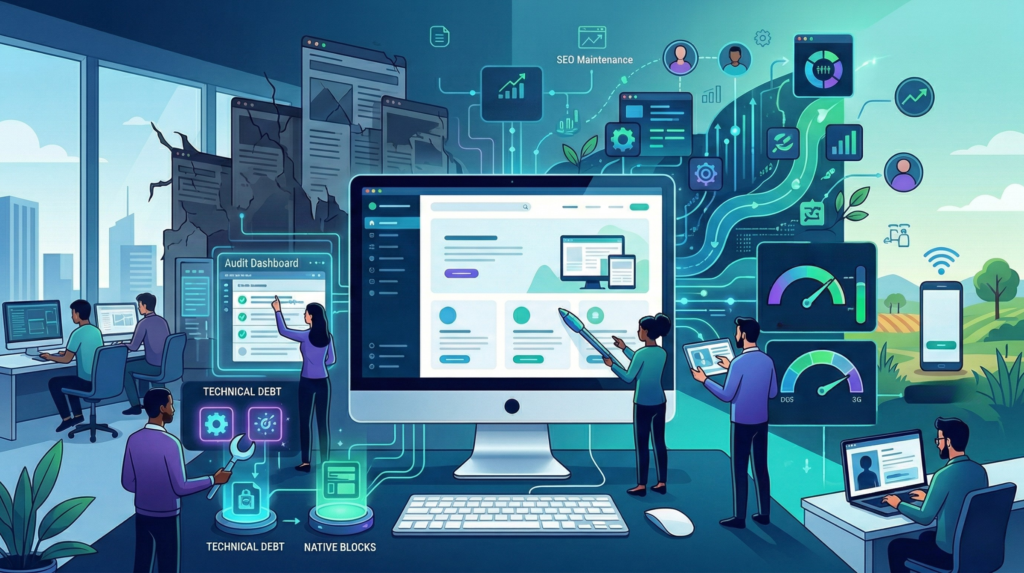
When you search for “how to build a website,” you are met with thousands of tutorials on choosing a host, picking a WordPress theme, or dragging blocks in a site builder. They make it sound like a “one and done” project.
However, the reality of maintaining a digital presence is often far different. Most articles forget to mention that a website isn’t a digital billboard; it’s a living organism. If you want to build a site that actually lasts more than a year without becoming a “digital ghost town,” you need to address these three rarely discussed factors.
1. The “Cognitive Load” of Your Design
Most SEO advice tells you to focus on User Experience (UX), but they rarely talk about Administrative Experience (AX).
If your website backend is overly complex full of “heavy” page builders and 50+ plugins you will eventually develop “update anxiety.” You’ll stop posting content because the process feels like a chore.
-
The Rare Tip: Build your site for your “laziest self.” Use native blocks (like Gutenberg) rather than heavy third-party builders to ensure that updating a blog post takes 5 minutes, not 50.
2. Designing for “Content Decay”
Traditional guides tell you to create “Evergreen Content.” What they don’t tell you is that even evergreen content rots. Links break, screenshots become outdated, and Google notices when a page hasn’t been touched in two years.
-
The Rare Tip: When building your site, create an Audit Dashboard. Instead of just a “Last Updated” date for readers, keep an internal log of when a page was last verified for accuracy. Sustainable SEO is about maintenance, not just production.
3. The “Hidden Weight” of Third-Party Scripts
Everyone knows “site speed matters,” but few articles discuss the Ethical and Performance cost of “Feature Creep.” Every time you add a “cool” tracking pixel, a chatbot, or a fancy font from an external server, you are selling a piece of your site’s speed and your user’s privacy.
-
The Rare Tip: Practice Digital Minimalism. Before adding a plugin, ask: “Does this feature provide more value than the 0.5 seconds of loading speed it will cost me?”
4. Accessibility Beyond “Alt Text”
Most articles mention Alt Text for images as an SEO “hack.” Real web accessibility is about Cognitive Inclusion.
-
The Rare Tip: Consider “Low Bandwidth” users. Not everyone has 5G or high speed fiber. Designing a site that is functional on a 3G connection in a rural area is a massive competitive advantage that most modern, “image-heavy” sites completely ignore.
5. Transitioning from “Owner” to “Editor”
The biggest reason websites fail is “Founder Burnout.” People start a site as a hobby or a solo business and try to do everything.
-
The Rare Tip: Build your site with Standard Operating Procedures (SOPs) from day one. Even if you are a solo creator, document how you resize images or how you format headers. This makes it possible to hand the site over to a virtual assistant later without the whole system collapsing.
Conclusion: Build for the Long Haul
A successful website isn’t defined by its launch day; it’s defined by its 500th day. By focusing on Administrative Ease, Digital Minimalism, and Content Maintenance, you aren’t just building a site you’re building a sustainable digital asset.
